Clear & Structured Content
Structured content means writing concise, definition-style sentences and breaking pages into scannable sections, so both people and answer engines can extract facts quickly.
Why it matters
Answer engines lift short, self-contained sentences and quote them. A fact buried in the middle of a long paragraph is harder to extract cleanly, so an engine may quote a competitor whose version is easier to lift. Human visitors behave much the same way — they scan for the fact they came for.
How to apply it
- Open every page with a definition sentence. "Acme Plumbing is a licensed emergency plumber servicing Richmond and Melbourne's inner east." That single sentence is the most quotable thing on the page.
- Use descriptive `<h2>` and `<h3>` headings. "Our call-out fees" beats "What we offer".
- Keep paragraphs to two or three sentences.
- Use bullet points for lists of services, prices, hours and service areas.
- Write sentences that stand alone. "We offer this in that area" means nothing lifted out of context. "Acme Plumbing offers blocked drain clearing across Richmond and Fitzroy" does.
The three-sentence test
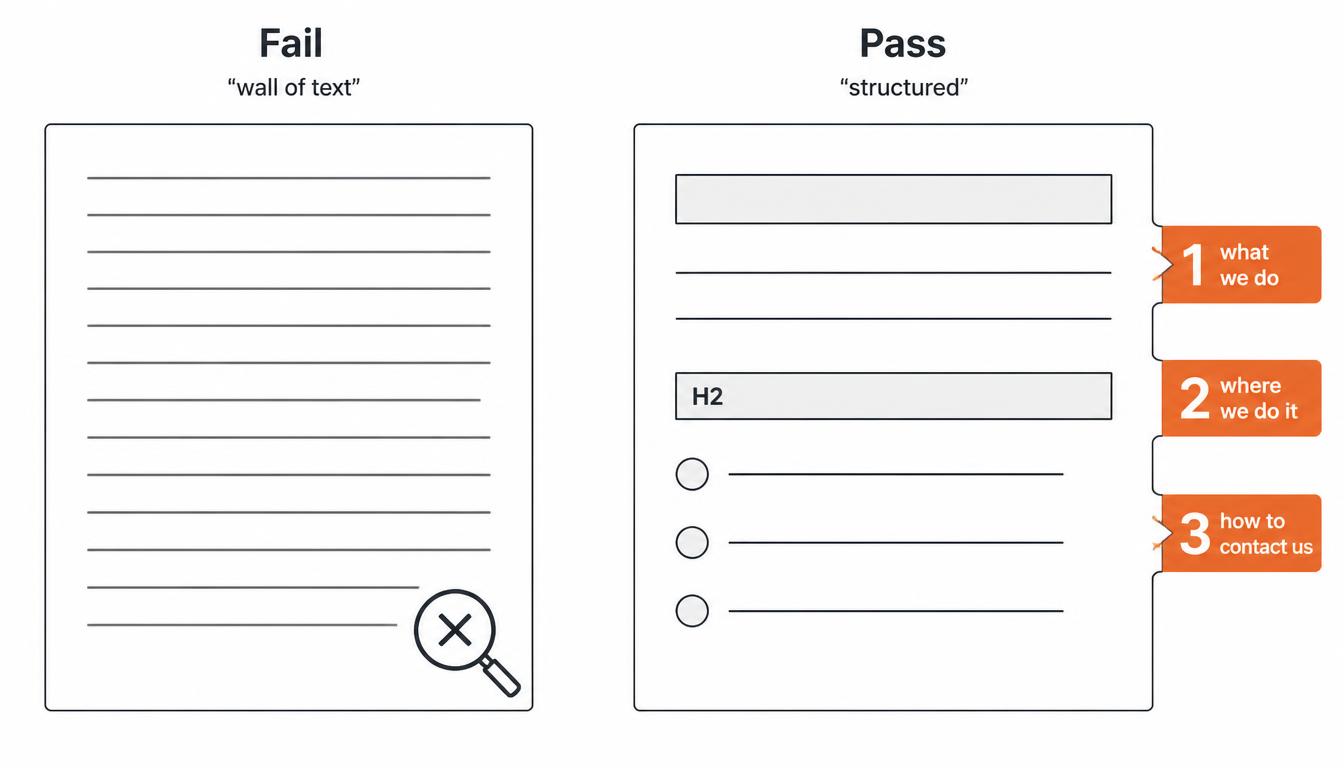
For every important page, ask: if an answer engine could only pull three sentences from this page, would those three tell a customer what we do, where we do it, and how to contact us?
If not, rewrite until they would.
Common mistakes
- Walls of text with no headings
- Clever headings that don't describe the section beneath them
- Pronouns and references that only make sense in sequence
- Prices and hours written in prose instead of a list
Quick answers
- How short should my paragraphs be?
- Two to three sentences. Long enough to make a point, short enough to scan.
- Does this hurt my writing style?
- It constrains it, but clarity and personality aren't opposites. Say the plain thing first, then add the character.
- Do headings actually matter to answer engines?
- They provide structure that makes content easier to segment and extract. They also help human readers, which is reason enough.